

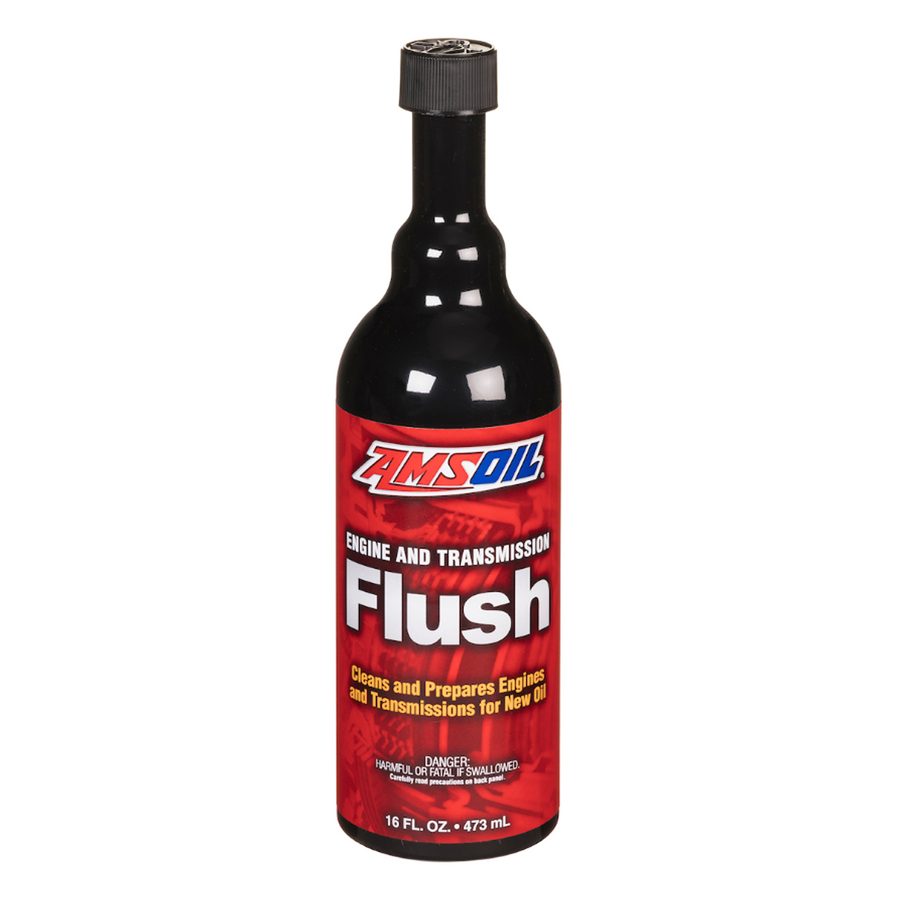
Product code FLSH
AMSOIL Engine and Transmission Flush
Preparation fluid for engine and transmission service
- Helps loosen sludge and deposits before a fluid change
- Suitable as a preparation step for engine or transmission service
- Used ahead of the finished oil or transmission fluid fill
To unlock up to 25% off, add an AMSOIL Preferred Customer membership to the same cart and qualifying products switch to member pricing immediately, with no separate sign-up step.
Product overview
Sludge and varnish do not leave on their own when the old fluid drains out. AMSOIL Engine and Transmission Flush is a pre-service cleaner that loosens deposits so they drain out with the used oil instead of staying behind to contaminate the new fill.
One 16-ounce bottle treats a sump of up to 10 quarts. It works in a single treatment and is safe enough to use at every oil change.
Where it is used
Use in:
- Gasoline engines
- Diesel engines
- Automatic transmissions
What the flush clears out before the refill
Deposits arrive through ordinary duty. Stop-and-go driving, prolonged idling, short trips that never let the engine reach full operating temperature, towing, ingested airborne dirt, fuel dilution, water condensation, and oxidized oil all promote sludge buildup in motor oil and transmission fluid. As that sludge settles it clogs narrow oil passages and restricts flow to vital parts, especially in the upper valve train area.
Inside an automatic transmission the symptoms look different. Deposits form on the clutch plates and show up as hesitation and erratic shifting, and clutch glazing can eventually set in and shorten the life of the transmission. AMSOIL Engine and Transmission Flush is a detergent-based cleaner that dissolves and disperses that sludge, varnish, and deposit buildup, clears deposits from the oil cooler and ports, and helps unclog restricted fluid passages.
Sizing the treatment to the sump
Dose follows sump volume, not engine size and not how dark the old fluid looks on the dipstick. One 16 oz. bottle treats a sump of up to 10 quarts, a 10 to 20 quart sump takes two bottles (32 oz.), a 20 to 30 quart sump takes three bottles (48 oz.), and a 30 to 40 quart sump takes four bottles (64 oz.).
The number to work from is the sump capacity published for that specific engine or transmission, rounded up to the next bracket rather than down. Each bottle goes in whole through the fill port, so a 12 quart sump takes both bottles rather than one and part of a second.
Circulated at idle, then drained with the old fluid
This is a pre-service cleaner rather than a lubricant that stays in the sump. The full dose goes into the fill port, the machine idles for 10 to 15 minutes so the detergents and dispersants can circulate, and then everything drains out with the used fluid before the finished oil goes back in. On a transmission the entire unit and the torque converter are drained, and the filter has to be changed before the refill.
The circulation step stays deliberately unloaded. With the emergency brake engaged, the transmission is shifted through drive and reverse while the vehicle is kept out of heavy load, and that is a condition of the procedure rather than an optional precaution. When a flushing machine handles the job instead, the machine manufacturer's recommendation governs. The formula is compatible with both petroleum and synthetic oils and with seals and gaskets, and it can be disposed of with the waste oil.
Where the flush should not be used
Two published restrictions define the edges of the job, and both are limits rather than selling points. The product is not recommended for differentials, so an axle service uses the gear lube that unit specifies with no flush step in front of it. Flushing is also not recommended on transmissions that do not have a removable pan or access to the transmission filter, which rules out sealed units where the filter cannot be changed before the refill.
Because the flush leaves with the old fluid, the fresh fill has to be on the bench before the pan comes off. A car or light-truck automatic takes the fluid its application list calls for, such as Signature Series Multi-Vehicle ATF, while severe-duty and commercial automatics are covered by Torque-Drive ATF. Neither one is interchangeable with the flush, which is formulated to clean and then leave.
How to use it
When a flushing machine is used, follow the machine manufacturer's recommendation. Otherwise:
- Engine: add the entire bottle to the engine oil fill port, idle the engine for 10 to 15 minutes, then immediately drain the oil and allow enough time for the system to drain completely. Remove and replace the oil filter, then refill with new oil in the viscosity grade the manufacturer recommends.
- Transmission: engage the emergency brake, add the entire bottle to the transmission fill port, and idle for 10 to 15 minutes while shifting through drive and reverse. Do not place the vehicle under heavy load. Drain the transmission and torque converter completely, and change the filter before refilling with new transmission fluid.
Good to know
- Not recommended for differentials.
Package sizes and product codes
| Product code | Package size | Unit |
|---|---|---|
| FLSHCN-EA | 16 oz. Bottle | Each |
| FLSHCN-CA | 16 oz. Bottle | Case of 12 |
| FLSH55-EA | 55 Gallon Drum | Each |
Select a product code to open that package size on the AMSOIL product page.
How much to use
Treat rates for larger sumps:
| Sump size | Bottles of flush |
|---|---|
| Up to 10 quarts | 1 bottle (16 oz.) |
| 10 to 20 quarts | 2 bottles (32 oz.) |
| 20 to 30 quarts | 3 bottles (48 oz.) |
| 30 to 40 quarts | 4 bottles (64 oz.) |
Product documents
AMSOIL publishes the full technical detail for this product in these documents.
- Engine and Transmission Flush product data bulletin (PDF)
- Engine and Transmission Flush safety data sheet (PDF)
Where to order
Confirm this formula is the match for the vehicle or equipment in the AMSOIL product guides, then order Engine and Transmission Flush online. Existing members can sign in to apply the discount automatically.
Details and questions
Is Engine and Transmission Flush a substitute for ATF?
When should a flush be used?
When preparing an engine or transmission for a fluid change and the service plan calls for a flush step. Follow the product directions on the package and do not leave flush in place as a long-term lubricant.
What does a transmission flush do?
Sludge and varnish do not leave on their own when the old fluid drains. The flush loosens those deposits so they drain out with the used oil instead of staying behind to contaminate the new fill.
How long does a transmission flush take?
Engage the emergency brake, add the entire bottle to the transmission fill port, and idle for 10 to 15 minutes while shifting through drive and reverse, with no heavy load on the vehicle. Then drain the transmission and torque converter completely and change the filter before refilling.
How much flush does one sump need?
One 16-ounce bottle treats a sump of up to 10 quarts. Larger sumps follow the treat rates in the table on this page.
How often can the flush be used?
It works in a single treatment and is safe enough to use at every oil change. Order AMSOIL Engine and Transmission Flush online in 16 oz. bottles, cases of 12, or 55 gallon drums.
Can it be used in a differential?
No. It is not recommended for differentials. It is for gasoline engines, diesel engines, and automatic transmissions.